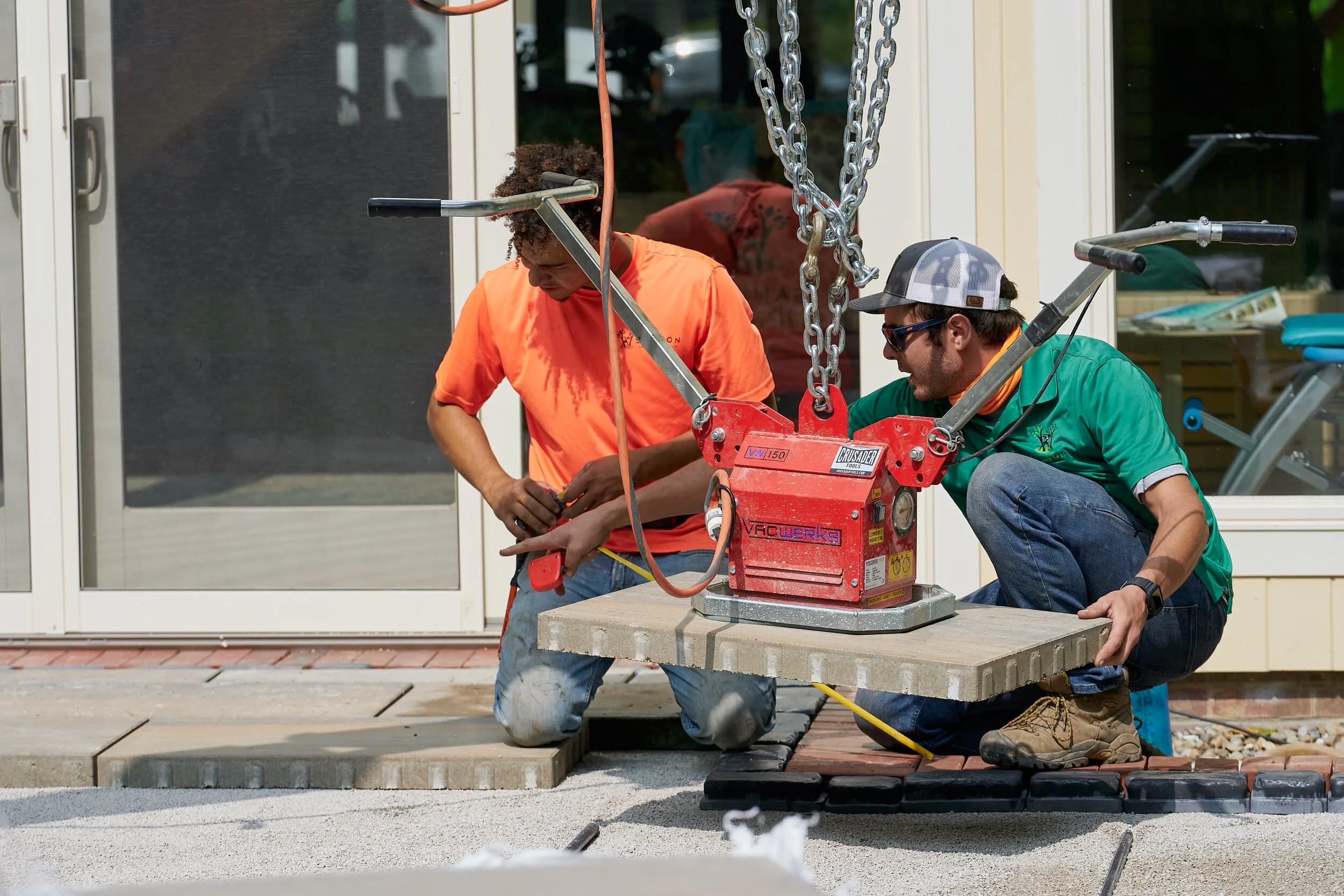
Start with a Plan
Most landscape projects that go over budget, run long, or end up looking disconnected share a common root cause: work started before a plan existed. A crew grades the yard, then another installs a patio, then someone plants along the edge — and none of it quite lines up because each decision was made in isolation. The fix isn't expensive; it's sequencing.
A good landscape plan doesn't need to be elaborate. At minimum it should answer three questions: What is the property being asked to do? (Entertain, drain better, look good from the street, handle a grade change?) What order do the phases of work go in? (Hardscape before planting — always. Grading before anything.) And what is the realistic budget for each phase?
For Northeast Ohio specifically, a plan should account for soil conditions, drainage patterns, and how the property behaves in spring. Clay soil, freeze-thaw cycles, and snowmelt all create conditions that look different in May than they do in August. Walking the site after a heavy rain is one of the most useful things you can do before making any decisions about grading, drainage, or plant placement.
Our process starts exactly here — site assessment before proposal, so the work we recommend actually solves the problem in front of us.
Landscape Design & Installation
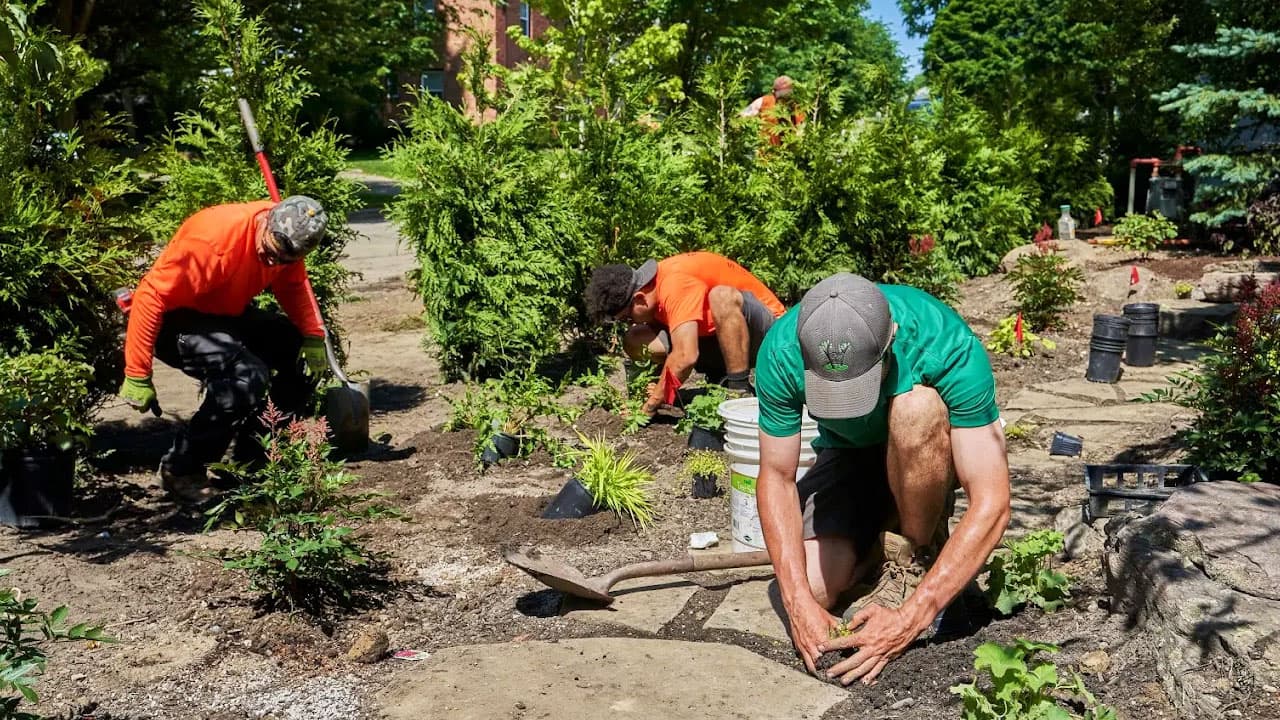
Landscape design in its broadest sense is the work of organizing a property so that all of its parts — grade, hardscape, planting, water, light — work together as a coherent whole. For residential properties in the Shaker Heights, Pepper Pike, and Chagrin Falls corridor, that usually means managing some combination of significant grade changes, mature tree canopy, heavy clay soil, and older infrastructure like crumbling driveways or failed retaining walls.
Our landscape design and install service covers the full scope: design development, permit coordination where needed, site prep, grading, hardscape installation, planting, and cleanup. We don't subcontract the installation out — the people who drew the plan are the ones building it.
Design Principles That Hold Up in Ohio
A few principles guide every design we put together for this climate:
- Grade drives everything. Water has to move away from the house, off hardscape surfaces, and toward an outlet. Planting plans, patio elevations, and wall heights are all downstream decisions from getting the grade right.
- Hardscape before softscape. Installing plants before hardscape is finished means tearing them out when the patio crew arrives. The correct sequence is: grading → hardscape → irrigation (if applicable) → planting → mulch.
- Design for four seasons. In Northeast Ohio, the landscape is visible for twelve months. A well-designed planting plan provides interest in winter through structure and bark texture, not just summer color.
- Match scale to the house. Planting beds scaled to a two-story Colonial need larger specimens and bolder masses than those flanking a ranch. The most common design mistake we see on existing properties is plants that are simply too small for the architecture behind them.
Use our landscape design calculator to get a rough sense of scope and cost before reaching out for a consultation.
Hardscape: Patios, Walls & Walkways
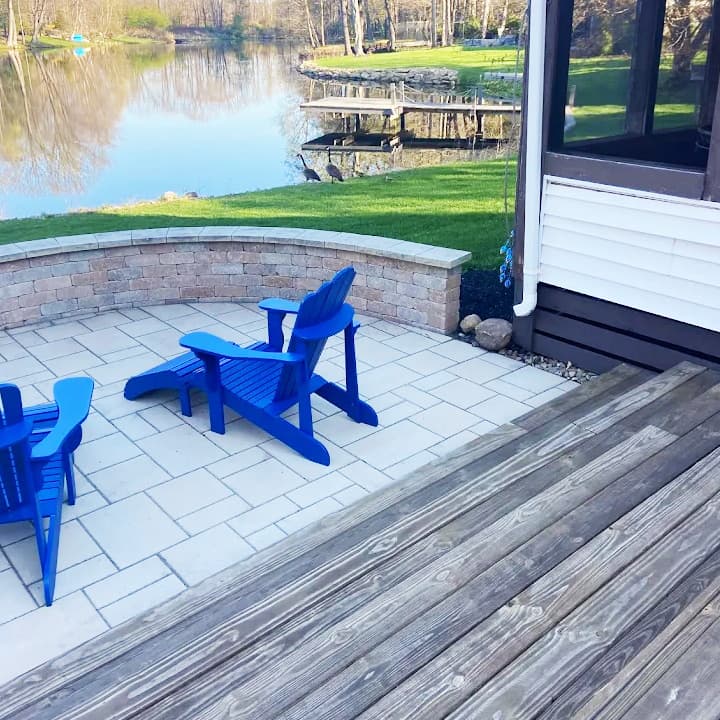
Hardscape is the backbone of a residential landscape. Done well, it defines outdoor living spaces, manages grade, controls where people walk, and gives the planting something to work against. Done poorly — thin base, wrong materials, no drainage detail — it heaves, cracks, and settles within a few winters.
Patios
The patio is usually the anchor of the outdoor living area and the most significant hardscape investment on a residential property. Material choice, size, layout, and relationship to the house all matter. We covered the material decision in detail in our patio materials guide — the short version is that concrete pavers are the right call for most Ohio homeowners (durable, repairable, design-flexible), thermal bluestone is the premium option for projects where the material quality matters as much as function, and poured concrete belongs on driveways and utilitarian pads rather than primary living spaces.
Size is consistently underestimated. A 10×12 patio feels adequate in a showroom and cramped the moment you put a table, four chairs, and a grill on it. We recommend a minimum of 16×20 for a primary entertaining patio, and larger if the house and yard support it. Use our patio cost calculator to estimate material and labor cost at different sizes before committing to a scope.
Our full patio installation work is detailed on the patios and retaining walls service page.
Retaining Walls
Any yard with meaningful grade change needs retaining walls somewhere in the design. Walls serve two functions simultaneously: they hold grade and they create usable flat space out of what was a slope. A terraced backyard with three 2-foot walls is fundamentally different from the same yard without them — it gains sitting areas, planting beds at accessible heights, and a visual structure that planting alone can't provide.
Wall material choices in Northeast Ohio narrow quickly under freeze-thaw pressure. Segmental retaining wall block (SRW) — the interlocking concrete block system — is the most reliable and cost-effective choice for walls up to 4 feet. Above 4 feet, engineered walls with geogrid reinforcement are required by most Ohio building codes. Natural boulders work well for informal walls and grade transitions. Mortared brick and dry-stack stone look great but require more maintenance in this climate.
Estimate your wall project with our retaining wall calculator.
Walkways & Driveways
Walkways do more than connect the driveway to the front door — they communicate something about the property from the street. A wide, well-lit front walk with clear geometry reads as intentional and welcoming. A narrow concrete path that wanders slightly off-center reads as afterthought.
For front entries, we typically use the same paver family as the patio (if there is one) to create visual continuity. For side yards and service paths, broom-finish concrete or a simple stepstone path is often the right call for budget reasons. Driveways in this region see serious abuse from snowplows and salt — permeable pavers are a good option for homeowners who want a durable driveway that also manages runoff and looks better than asphalt.
See our walkways and driveways page and use the walkway and driveway calculator to scope your project.
Plant Installation
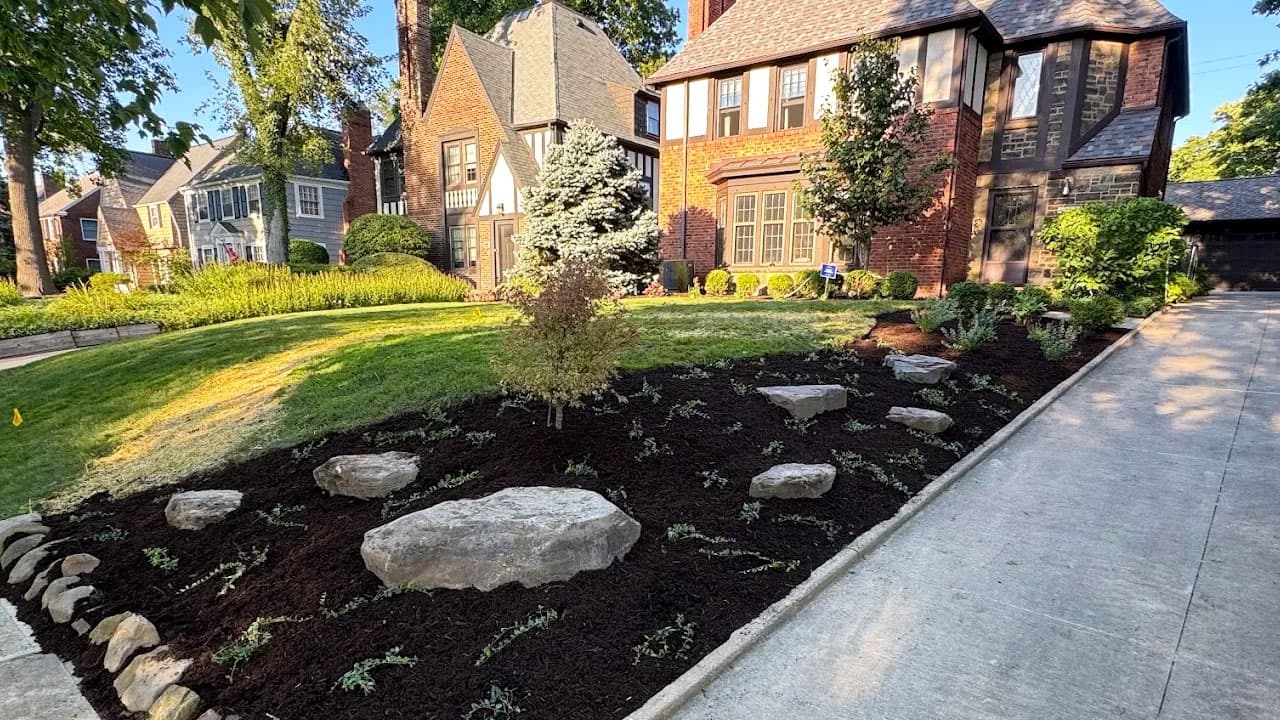
Plants are what give a landscape its character over time — they soften hardscape edges, provide seasonal color and texture, attract birds and pollinators, and ultimately make a property feel alive in a way that stone and mulch alone never will. They're also where most of the long-term maintenance either gets created or avoided, depending on how well the selection matches the site.
We cover plant selection for this region in detail in our guide to choosing plants for Northeast Ohio. The abbreviated version: Zone 6a hardiness matters, clay soil requires amendment, and Ohio native species are almost always the right choice for low-maintenance planting plans.
Trees
Trees are the longest-term decision in any landscape. A 3-inch caliper tree planted today will be a 30-foot canopy tree in 20 years — and it will be nearly impossible to remove or relocate without serious cost and disruption. Get the placement right at the start. Clearances from the house (15 feet minimum for most ornamentals, 25+ for large-canopy species), from utilities, from existing hardscape, and from sight lines all matter.
Ohio natives that perform consistently well as specimen or shade trees: Eastern Redbud (Cercis canadensis), Serviceberry (Amelanchier spp.), Ohio Buckeye (Aesculus glabra), and Swamp White Oak (Quercus bicolor) for wet areas. Avoid Norway Maple and Callery Pear — both are invasive and increasingly restricted in Ohio.
Shrubs and Foundation Planting
Foundation planting — the shrubs and perennials along the base of the house — is where most homeowners eventually end up ripping things out and starting over. The most common mistake is planting fast-growing shrubs that look good at 3 feet and block windows at 8. We design foundation beds with mature size as the constraint, not the planting-day size.
For Northeast Ohio foundations: Inkberry Holly (Ilex glabra) for wet-shade corners, Dwarf Fothergilla for four-season interest, Little Lime Hydrangea for sun positions with manageable size, and Karl Foerster Feather Reed Grass for textural contrast at corners.
Perennials and Seasonal Color
Perennials are the workhorses of the planted landscape — they return each year, they spread and fill over time, and the right choices require almost no maintenance once established. We lean heavily on native perennials: Wild Blue Indigo (Baptisia), Black-eyed Susan (Rudbeckia), Purple Coneflower (Echinacea), and New England Aster for late-season color.
Our plant finder tool lets you filter by sun exposure, moisture preference, and bloom time to narrow down species that fit your specific conditions. Our full plant installation service covers everything from single-bed refreshes to full-property plantings.
Drainage
Drainage is the most underinvested part of most residential landscapes, and it causes more downstream problems than any other single issue. Poor drainage kills grass and plants, accelerates hardscape deterioration, creates chronic wet-basement conditions, and makes the yard unusable for half the spring. It's also almost always fixable — usually without tearing up the entire yard.
Surface Grading
The first line of defense is grade. Every flat or low-lying surface on a property should slope away from structures at a minimum of 2% (roughly 1/4 inch per foot). Foundations, patios, walkways, and planting bed edges all need to direct water away, not toward or parallel to the house. Most drainage problems we investigate start here — soil settles against foundations over time, creating a reverse grade that quietly routes water toward the basement for years.
Use our grading and leveling calculator to estimate the scope of a regrading project.
French Drains
When surface regrading isn't enough — because water is rising from below, or the topography doesn't provide a natural outlet — a French drain is the right tool. A perforated pipe in a gravel-filled trench, sloped to daylight, collects subsurface water and moves it away from the problem area. Done right with filter fabric and clean drainage stone, it functions for 20–30 years with minimal maintenance.
We covered French drains in detail in our complete guide to French drain installation, including how to tell whether you actually need one, how we design and route them, and what long-term maintenance looks like. Our drainage and French drains service covers the full range from simple surface corrections to complex multi-outlet systems.
Downspout Management
Every downspout on a house is discharging water at a concentrated point. A single downspout during a moderate rain event can deliver 12–15 gallons per minute — directly against a foundation, under a patio, or into an already-saturated planting bed. Extension leaders that run 6 feet onto the lawn are better than nothing. Buried solid PVC piped to daylight is a real fix. Dry wells work for lower-volume situations where there's no downhill outlet available.
Backyard Remodels
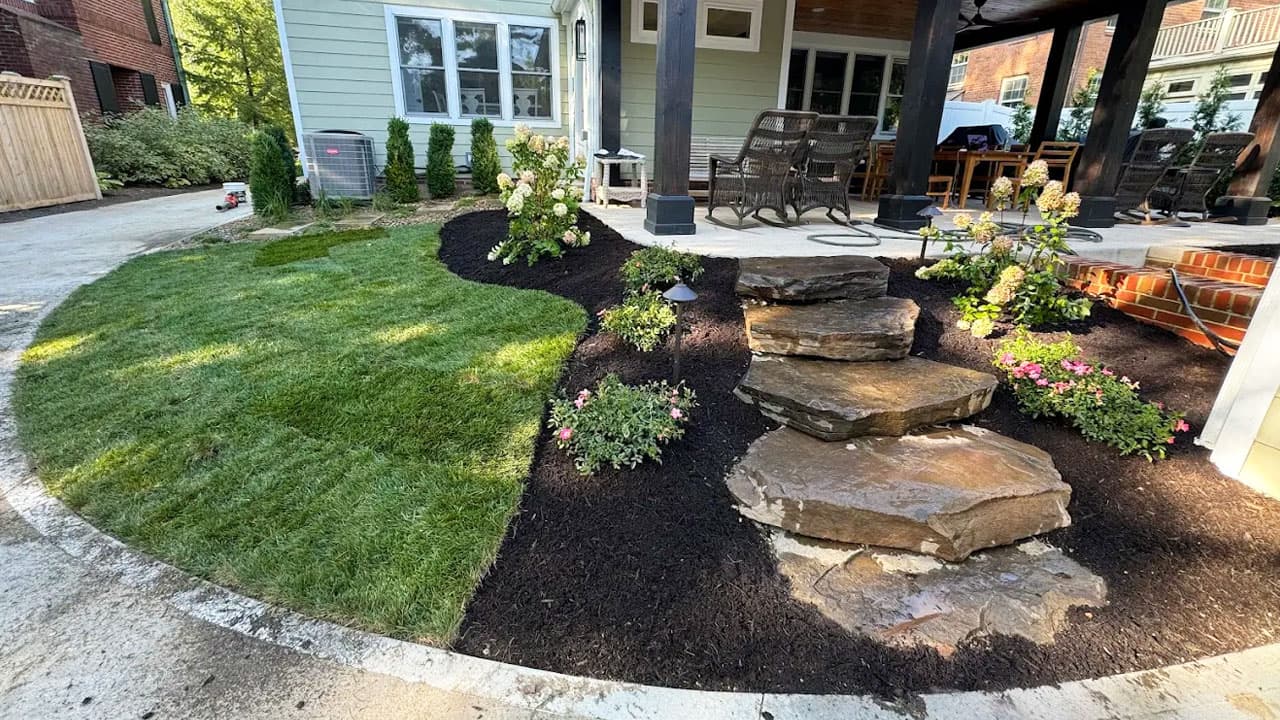
A backyard remodel is the combination work — the project that transforms a neglected or underperforming backyard into a functional outdoor living space by addressing hardscape, planting, drainage, and lighting together rather than piecemeal. The result is a cohesive space rather than a collection of disconnected improvements.
Most backyard remodels we do in Northeast Ohio share a common starting condition: a usable but unloved space — flat lawn bordered by overgrown foundation plantings, a cracked concrete patio from the 80s, drainage that makes the back corner unusable for two months every spring. The transformation usually involves demo of the existing patio, regrading for drainage, a new paver patio with defined edges, low retaining walls to create terraced planting beds, fresh planting throughout, and lighting to make the space usable after dark.
What separates a remodel from a collection of individual projects is design integration. All the decisions — patio size and material, wall heights, planting palette, lighting placement — are made together against a unified vision for how the space should function and feel. See our backyard remodels service page for project examples and scope details.
What a Realistic Remodel Scope Looks Like
- Demo and disposal — removing existing hardscape, overgrown shrubs, and debris before any new work begins
- Grading and drainage — establishing correct slope away from the house and routing surface water to an outlet
- Base prep — 6+ inches of compacted aggregate base for all hardscape areas
- Hardscape installation — patio, sitting walls, retaining walls, steps, edging
- Planting — trees, shrubs, perennials, and ground cover selected for the specific light and moisture conditions of the space
- Lighting — low-voltage path lights, uplights, and step lights wired and installed at the same time as hardscape where possible
- Mulch and cleanup — finished presentation ready for use
Excavation
Excavation is the infrastructure work that makes everything else possible. Before a retaining wall can go in, before a patio base can be compacted, before a French drain can be routed — material has to come out of the ground. For residential properties in Northeast Ohio, this usually means working in tight spaces with constrained equipment access, managing clay spoils, and coordinating around existing utilities, mature tree roots, and structures.
We operate compact excavators, skid steers, and hand equipment across all of our hardscape and drainage projects. For larger scope work — basement excavation, significant site grading, retaining wall footings — our Cleveland excavation service handles standalone excavation contracts as well as integrated project work.
What Excavation Work Typically Involves
- Site stripping — removing topsoil layer and organic material from areas receiving hardscape base; organic material under compacted stone is what causes long-term settling
- Grade cuts and fills — cutting high spots and filling low areas to establish design grade; in clay soils, fills require compaction in lifts to prevent future settlement
- Trench excavation — for French drains, buried downspout runs, wall footings, and utility work
- Spoils hauling — clay spoils from NE Ohio sites are heavy; most residential excavation projects generate more material than can be redistributed on-site, requiring truck-out and disposal
Always call 811 before any excavation — Ohio law requires utility locates 48 hours before digging. This applies to contractors as well as homeowners.
Landscape Lighting
Landscape lighting is the most underutilized tool in residential outdoor design. A property that looks finished and polished during the day can look flat and uninviting at 8 pm — or it can look genuinely dramatic, with depth, shadow, and warmth that the daylight version can't replicate. The difference is deliberate lighting design, not just fixtures screwed into the ground along a path.
All of our lighting work uses low-voltage LED systems — energy-efficient, long-life, and controllable via timer or smart home integration. Fixtures go in during hardscape installation where possible, so wire runs can be buried cleanly under the patio base rather than trenched in after the fact.
Lighting Techniques That Actually Work
- Uplighting trees — a single well-placed fixture at the base of a mature specimen tree creates a focal point visible from both inside the house and the street; aim for 2700K color temperature to keep it warm rather than clinical
- Grazing hardscape — fixtures mounted low and angled across a stone wall or paver surface reveal the texture of the material in a way that flat overhead light erases
- Path lighting — the goal is to light the ground, not create glare; low shrouded fixtures that cast a pool of light downward are more effective and more comfortable than exposed-bulb bollards
- Step lighting — recessed into the riser of each step, step lights improve safety and add a clean architectural detail; they should be planned before walls are built, not added afterward
- Silhouetting — placing a fixture behind a plant against a wall or fence creates a shadow-play effect that works particularly well with ornamental grasses and multi-stem trees
See our full landscape lighting service page for examples and information about our LED system installations.
Sequencing Your Project
One of the most common questions we get before a project starts: what order does everything go in? The answer matters because mistakes in sequencing create expensive rework. Here is the correct sequence for a full-scope landscape project:
- 1. Design and site assessment — before any shovels go in the ground, confirm the plan, check grades, mark utilities
- 2. Demo — remove existing hardscape, overgrown plants, and anything that won't survive the construction process
- 3. Rough grading and drainage — establish design grades, install French drains and buried drainage runs, set elevations for hardscape
- 4. Hardscape — retaining walls first (they set elevation relationships), then patio, then walkways and steps; base prep and compaction before any surface material goes down
- 5. Irrigation (if applicable) — much easier to run lines before planting than after
- 6. Planting — trees first (hardest to place, most affected by overhead clearances), then shrubs, then perennials and ground covers
- 7. Lighting — fixture placement and final wire terminations after planting is in, so positioning can respond to the actual plant locations
- 8. Mulch and final cleanup — beds mulched 2–3 inches deep, hardscape cleaned, final grade check on lawn areas
Projects phased across multiple years should still follow this logic within each phase. If you're doing the patio this year and the planting next year, end this year's work with rough bed preparation so next year's crew isn't working around finished hardscape.
If you're ready to start planning a project, reach out through our contact page and we'll schedule a site visit. Or use our landscape design calculator to build a rough budget estimate before we talk.
